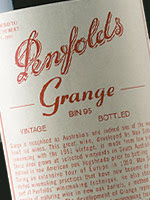
Most people find it hard to imagine that the Australian wine industry could possibly be in trouble. Isn't Australia the great success story of wine's current globalization era? Australian wines are the #1 imports in Great Britain, having overtaken the French, and they may soon replace Italy as the #1 wine import in the United States. Where is the trouble in this?
And aren't Australia's best wines, like the iconic
Penfolds Grange shown here, recognized as among the finest wines in the world? Australian Shiraz has set a high standard and its popularity has ignited interest in Shiraz and Syrah around the world. What's wrong with that?
And yet big trouble there is for Australia's wine industry and it is important to understand the situation both to appreciate the forces at work in Australia and to recognize their impact on the rest of the wine world.
First, however, we have to understand how Australian wine really works. Although famous brands like Penfolds Grange established Australia's reputation for fine wines, they are a small and limited segment of the market. The evolution of Australian wine during the 1990s has produced an industry dominated by a small number of very large producers focused on branded products for export to Great Britain and the United States (about 75% of Australian wine exports are aimed at these two markets).
The bulk of Australia's exports are inexpensive bulk wines, like the
Yellow Tail brand that sells so well in the U.S. In fact, Yellow Tail wines account for nearly one-third of all Australia's exports, making the industry incredibly dependent upon market conditions at the bottom end of the market. And those market conditions are not favorable: price competition is fierce. Penfolds Grange is the sophisticated image of Australian wine, but Yellow Tail, with more than 10 million export cases per year, is the inexpensive "critter wine" that pays the bills.

Or doesn't pay the bills. Three years of rising harvests from 2004-2006 left Australia awash in bulk wine and the market worked just like the textbook says: prices dropped. The fact there is surplus wine, at least for now, in many parts of the world made the situation worse, of course. Bulk wine export prices are now less than 85 cents per liter, an unsustainable level.
I have read some reports that suggest that cheap French wines are part of the problem. The wine industry in the South of France,the Languedoc, is badly fragmented, with tiny family vineyards that can undercut new world wines because they do not count the cost of inherited capital (the vineyards) or family labor. And, of course, there are those EU subsidies, at least for now.
The wine world has become very small and Australian bulk producers compete head to head with those from Chile and France in the main global markets. And this creates a problem, too, because there is only so much demand to go around at any given time. If Australia exports a bit more to the U.S., for example, it pushes that extra U.S. wine into an export market, where it undercuts existing Australian sales. The result, once again, is falling price. Australian wine producers are on the lookout for new markets, focusing on Russia, China and South Korea. I would guess that these are not the easiest markets to enter except through the undesirable bulk wine route.
The problem is compounded by the fact that Australia's big brands seem to have hit a wall in the export markets. Everyone has "critter" wines, now (or haven't you noticed) and the competition among branded wine products has become positively frenzied. Sales of some of the Australian "popular premium" brands have actually declined for the first time, with these wines pushed down into the bulk market, pulling prices even lower there. More and more, Australian wines compete in a single category and market conditions on that part of the wine rack have deteriorated.
There is good news, but even the good news is bad. The good news is that the Australian wine surplus is shrinking and supply is becoming more closely aligned with demand. The bad news is that this isn't because demand is rising, but rather because 2007 was a disastrous vintage. Grade production fell by 30% due to disease, frost and especially drought. Drought conditions are projected to continue into 2008, so there is not much hope of a quick recovery. Bad news is sometimes good news in agricultural markets, where bad crops push up prices and make people rich. But Australia's bad crop won't do much to push up global bulk wine prices. The only good news is that the surplus stocks that Australian producers have been holding can be used up at last.

What can be done? The
Australian Wine and Brandy Corporation (a government marketing agency) has released a study titled
Wine Australia: Directions to 2025 that presents a plan to turn the troubled industry around without ripping out vines the way that they did in Canada and New Zealand during their wine gluts in the 1980s and the European Union proposes to do to shrink their wine lake now. The key to the plan is to "re-brand" Australian wines using a market segmentation scheme described in the report and then to move up market and away from bulk wines with more innovative brands and an attempt to focus on distintive regional
terroir.The logic is simple: move from the bottom shelf in the supermarket, where prices are unsustainable in any case, into the middle and top shelves, where consumers are willing to pay higher prices. The problem? Well, changing consumer expectations isn't easy, although it is possible. But isn't
everyone trying to do that? It seems like every winemaker is trying to move upmarket. Gallo and Constellation have dozens of brands in these market segments, with more coming every day. (Just this week, as it happens, Gallo announced a partnership with Martha Stewart to produce a Sonoma-sourced Martha Steward Vintage brand wine to sell for $15 in select markets!)
The Wine Australia report is a good beginning. They recognize the current crisis and they know what to do. But can they do it?
 An article in today's (9/27/07) Wall Street Journal suggests that the era of wine surpluses, both in the world and especially in Australia (see previous blog entry below) may be coming to an end. The world's second largest winemaker has started to raise prices on its premium wine after a long period of discounting and drastic bulk sales. Maybe this market cycle has finally hit bottom and prices are on their way up.


